G10 Biology Study Guide
6 Lessons: Chemistry of Life, Macromolecules, Proteins & Enzymes
The Chemistry of Life
Life is built from four key elements: Carbon (C), Hydrogen (H), Oxygen (O), and Nitrogen (N). Understanding atomic bonding is foundational to biology.
| Term | Definition | Example |
|---|---|---|
| Element | Cannot be broken down into simpler substances | Carbon, Oxygen |
| Atom | Smallest unit of an element | A single carbon atom |
| Molecule | Two or more atoms joined by chemical bonds | H₂O (water) |
| Covalent Bond | Sharing electrons between atoms | C–H bond in glucose |
| Ionic Bond | Transfer of electrons; opposite charges attract | NaCl (salt) |
| Valence Shell | Outermost electron shell; atoms bond to fill it | Carbon has 4 valence e⁻ |
Carbon: The Backbone of Life
Carbon has 4 valence electrons → forms 4 covalent bonds. This versatility makes carbon the foundation of all organic molecules. Organic = containing C found in living systems. Exception: CO₂ and carbonates are inorganic.
| Property | Organic | Inorganic |
|---|---|---|
| Definition | Contains carbon, found in living systems | Does not contain C–H bonds |
| Examples | Glucose, proteins, DNA, lipids | CO₂, H₂O, NaCl |
💡Key Exception
CO₂ contains carbon but is INORGANIC because it lacks C–H bonds.
Protein powder is a popular supplement. The key question: How do the chemicals in protein powder help absorb proteins? Enzymes in the digestive system break peptide bonds via hydrolysis, releasing amino acids for absorption in the intestine.
Building Biomolecules
Life depends on four classes of macromolecules. All contain carbon and are built from smaller subunits (monomers).
| Biomolecule | Elements | Monomer | Polymer | Shape |
|---|---|---|---|---|
| Carbohydrates | C, H, O (1:2:1) | Monosaccharide | Polysaccharide | Ring (hexagon) |
| Lipids | C, H, O (much more C & H) | Glycerol + Fatty Acids | Not a true polymer | Long chain |
| Proteins | C, H, O, N (some S) | Amino Acid | Polypeptide | Central C + NH₂ + COOH + R |
| Nucleic Acids | C, H, O, N, P | Nucleotide | DNA / RNA | Chain of nucleotides |
📊Element Mnemonic: CHO / CHON / CHONP
Carbs & Lipids = CHO
Proteins = CHON
Nucleic Acids = CHONP
⚠️Watch Out: Carbs vs Lipids
Both contain only CHO! Lipids have MUCH MORE C and H relative to O and form long chains. Carbs have a 1:2:1 ratio.
Metabolism & Macromolecules
| Concept | Definition | Analogy |
|---|---|---|
| Monomer | A single building block unit | 1 Lego block |
| Polymer | A chain of many monomers | Lego building |
| Polymerization | Process of linking monomers into polymers | Snapping Legos together |
| Reaction | What Happens | Water | Metabolism |
|---|---|---|---|
| Condensation | Monomers join → polymer | RELEASED | Anabolism (合成代谢) |
| Hydrolysis | Polymer → monomers | USED | Catabolism (分解代谢) |
📊Metabolism Definitions
Metabolism = all enzyme-catalyzed reactions in a cell
Anabolism = building complex molecules (condensation)
Catabolism = breaking complex molecules (hydrolysis)
| Macromolecule | Key Functions | Examples | Build / Break |
|---|---|---|---|
| Carbohydrates | Fast energy, structural support, storage | Glucose, starch, glycogen, cellulose | Condensation / Hydrolysis |
| Lipids | Long-term energy, membrane, insulation, hormones | Oil, butter, wax, cholesterol | N/A |
| Proteins | Structure, transport, enzymes, antibodies | Collagen, hemoglobin, insulin | Condensation / Hydrolysis |
| Nucleic Acids | Store & transmit genetic info | DNA, RNA | Condensation / Hydrolysis |
Protein Structure & Function
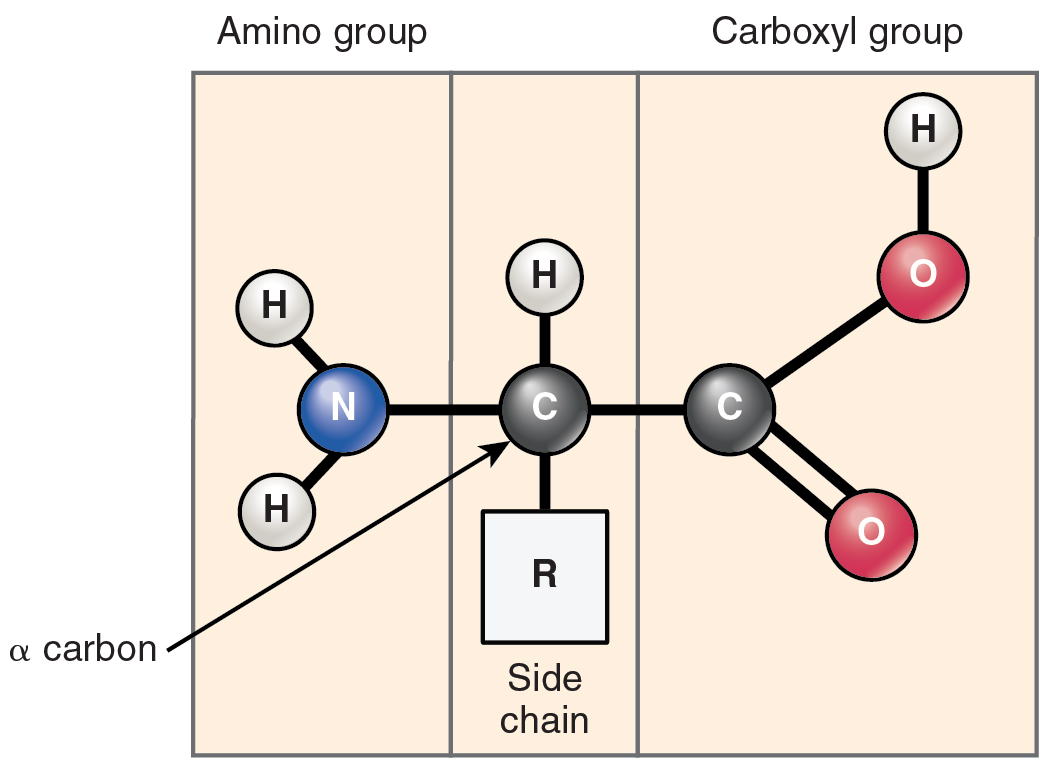
20 different amino acids exist in nature. Each has three parts:
Amino group
Carboxyl group
(unique per amino acid)
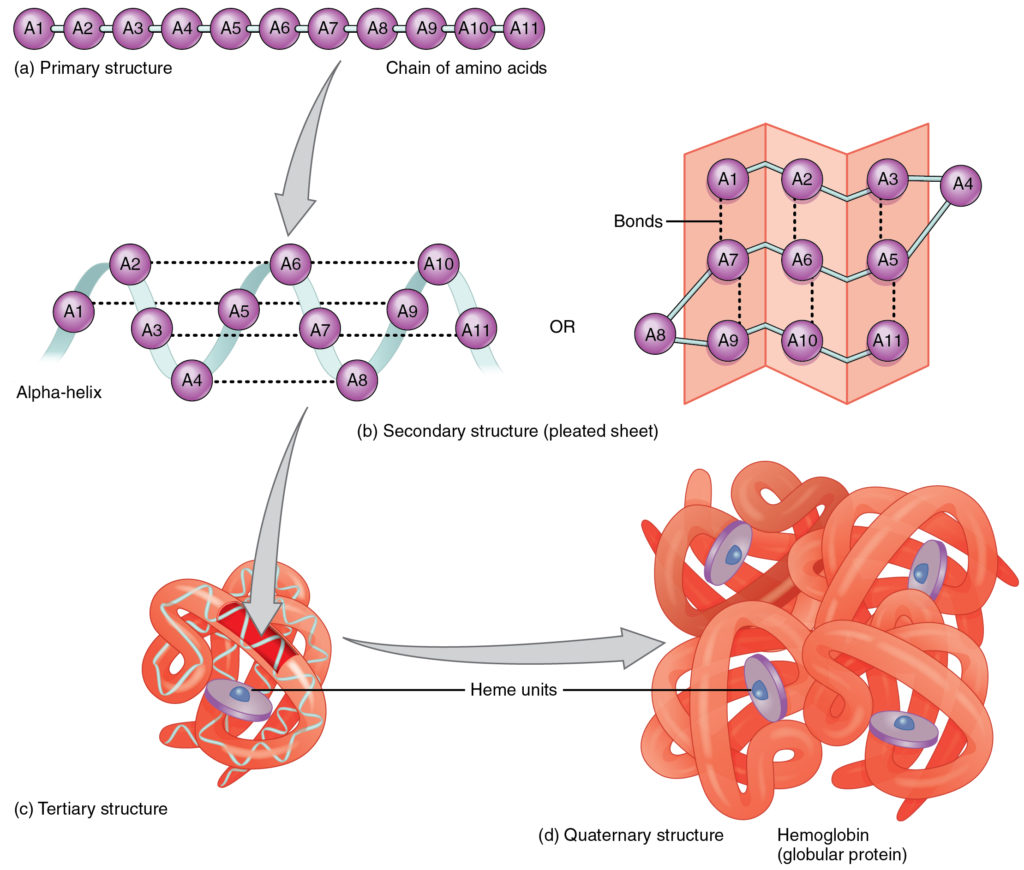
Amino acids link via PEPTIDE BONDS (covalent) through condensation. Chain = POLYPEPTIDE. Sequence (coded by DNA) determines 3D structure → function.
| Level | Name | Description | Bond |
|---|---|---|---|
| 1 | Primary | Sequence of amino acids | Peptide bonds |
| 2 | Secondary | Folding (α-helix, β-sheet) | Hydrogen bonds |
| 3 | Tertiary | 3D arrangement | H-bonds, disulfide, ionic |
| 4 | Quaternary | Multiple polypeptides | Same as tertiary |
| Feature | Fibrous | Globular |
|---|---|---|
| Shape | Long strands | Rounded |
| Role | Structural support | Functional (transport, catalytic) |
| Solubility | Less soluble | More soluble |
| Examples | Collagen, Keratin, Actin | Hemoglobin, Insulin, Enzymes |
⛔Denaturation = Irreversible!
Caused by extreme pH or high temperature. Destroys secondary, tertiary, quaternary structure. Primary structure (amino acid sequence) remains intact.
Example Proteins
| Protein | Structure | Function |
|---|---|---|
| Insulin | 2 chains (21 + 30 AA) | Hormone; regulates blood sugar |
| Collagen | Triple helix | Skin, tendon, bone support |
| Hemoglobin | 4 subunits | Transports O₂ in blood |
📊Proteome vs Genome
Genome = complete set of genes
Proteome = complete set of proteins
Every individual has a UNIQUE proteome.
Enzymes
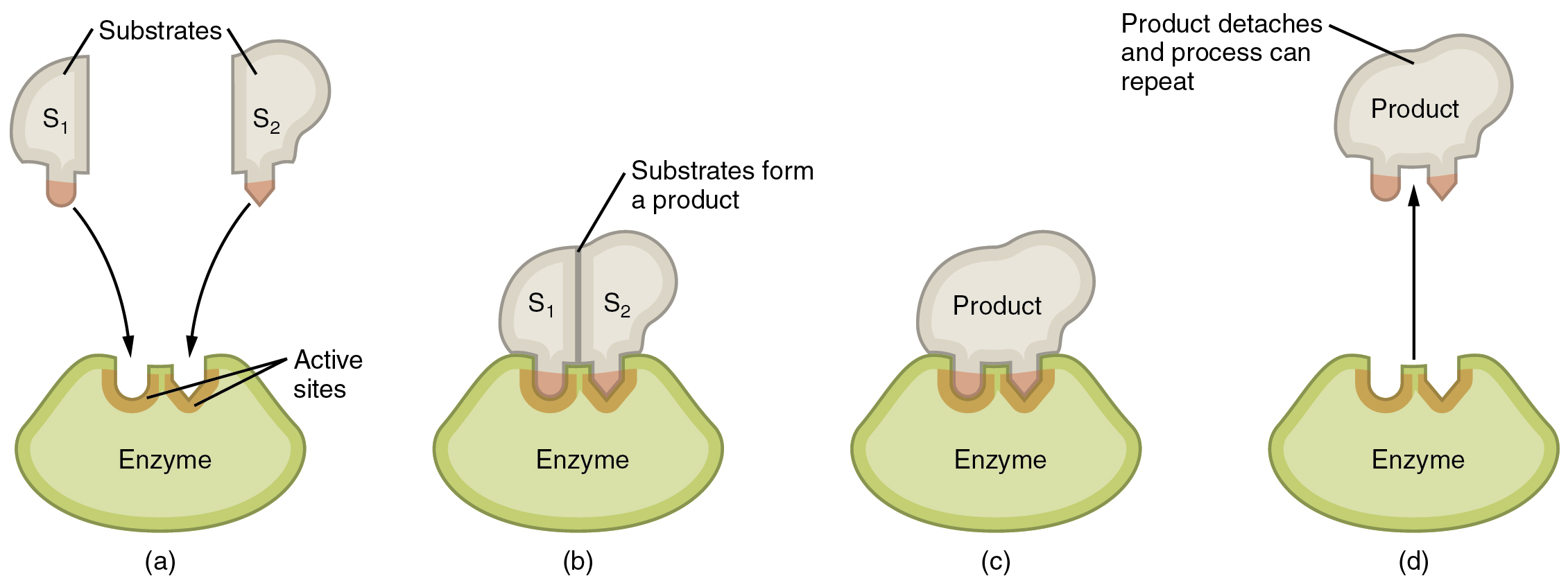
Enzymes are LARGE GLOBULAR PROTEINS acting as organic catalysts. They lower activation energy, increase reaction rates, are NOT consumed, and work at low concentrations.
| Key Term | Definition |
|---|---|
| Enzyme | Globular protein catalyst |
| Active Site | Region where substrate binds |
| Substrate | Molecule the enzyme acts on |
| Activation Energy | Minimum energy to start a reaction |
| Saturation | All active sites occupied |
Two Models of Enzyme Specificity
The active site fits the substrate perfectly like a key in a lock. The active site is a rigid, exact shape.
The active site changes shape slightly when substrate binds — like a glove fitting around a hand. This is the MORE ACCURATE model.
Phenomenon: Lactose Intolerance
Lactose (milk sugar) is broken by LACTASE into glucose + galactose. Insufficient lactase → undigested lactose → bacteria produce CO₂, H₂, methane → bloating. Lactose intolerance is the NATURAL state for most mammals.
Effect of Temperature
Effect of pH
Effect of Substrate Concentration
💡Key Insight
At saturation, increasing substrate has NO EFFECT. To go faster, you need more enzyme.
⛔How Enzymes Denature
High temperature: Extra kinetic energy → vibration → breaks bonds → active site changes
Extreme pH: Breaks hydrogen bonds → active site changes
Result: Substrate CANNOT bind → enzyme stops. IRREVERSIBLE.
Master Comparison Table
| Carbs | Lipids | Proteins | Nucleic Acids | |
|---|---|---|---|---|
| Elements | C, H, O | C, H, O | C, H, O, N (S) | C, H, O, N, P |
| Monomer | Monosaccharide | Glycerol + Fatty Acids | Amino Acid | Nucleotide |
| Polymer | Polysaccharide | Not a true polymer | Polypeptide | DNA / RNA |
| Energy Role | FAST energy | LONG-TERM storage | Structural, transport | Genetic info |
| Examples | Glucose, starch, glycogen | Butter, oil, wax, cholesterol | Collagen, hemoglobin, insulin | DNA, RNA |
| Build | Condensation | N/A | Condensation | Condensation |
| Break | Hydrolysis | N/A | Hydrolysis | Hydrolysis |
Key Definitions Glossary
| Term | Definition | Term | Definition |
|---|---|---|---|
| Matter | Has mass and takes up space | Anabolism | Building up molecules |
| Element | Cannot be broken down further | Catabolism | Breaking down molecules |
| Covalent Bond | Sharing electrons | Denaturation | Loss of 3D structure (irreversible) |
| Monomer | Single building block | Proteome | Complete set of proteins |
| Polymer | Chain of many monomers | Active Site | Region where substrate binds |
| Condensation | Monomers join; H₂O released | Enzyme | Globular protein catalyst |
| Hydrolysis | Polymer broken; H₂O used | Lactase | Breaks lactose → glucose + galactose |